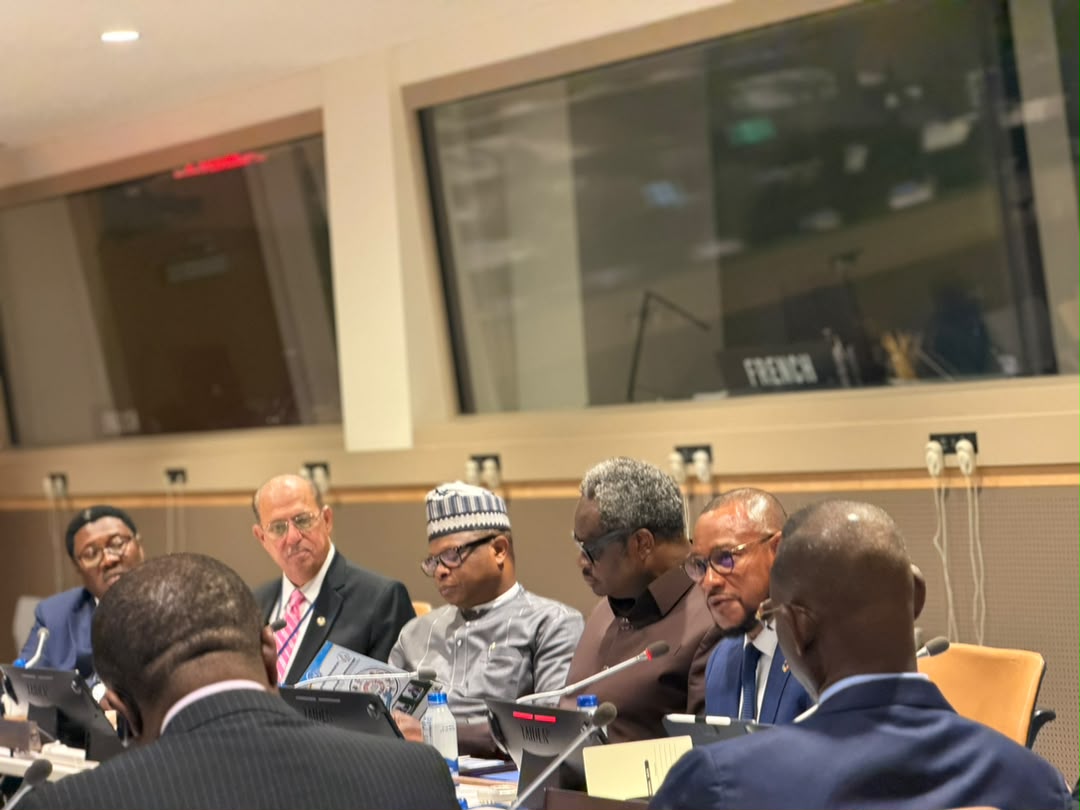

UNGA Roundtable discussion brief
18/06/2026
Excellencies, distinguished guests, colleagues, ladies and gentlemen, thank you for the opportunity to join this discussion on sustainable global investment, economic resilience and climate financing. These are three large ideas, and they are often discussed as separate agendas. I would like to bring them together around one practical question: how do we build productive economies today, ensure that they can withstand the shocks of tomorrow, and preserve the economic, social and natural assets on which future prosperity depends?
For me, the relationship is straightforward. Sustainable global investment builds the productive capacity required for long-term prosperity. Economic resilience describes the ability of that capacity to endure, adapt and continue creating value when conditions change. Climate financing supports the part of this investment that is directed toward mitigation, adaptation and resilience, while widening the financing options available for climate-related projects that may otherwise struggle to attract conventional capital.
This relationship has particular relevance for Africa because a large part of the productive capacity we will need over the next several decades still has to be built. In 2024, about 560 million people in Sub-Saharan Africa still lacked access to electricity. Reliable power is not simply a social service; it supports agriculture, manufacturing, healthcare, digital services, small businesses and productive employment. Beyond electricity, the African Development Bank estimates that Africa requires between US$130 billion and US$170 billion of infrastructure investment every year, with an annual financing gap of roughly US$68 billion to US$108 billion. The same challenge appears across industry, food systems and employment. African manufacturing value added rose from about US$285 billion in 2020 to US$351 billion in 2025, yet the continent still accounted for less than 2% of global manufacturing output and only 1.4% of global manufactured exports. FAO estimates that 309 million people in Africa experienced hunger in 2025, while 56.6% of the population experienced moderate or severe food insecurity. At the same time, around 10 to 12 million young Africans enter the labour force each year, while only about 3 million formal jobs are currently created annually. These figures point to the scale of the productive base Africa still has to build: electricity systems that can support businesses and industry, infrastructure that connects markets, food systems that can feed growing populations, industrial capacity that retains more value on the continent, and enterprises that can create jobs at scale.
We also have to build this productive base in a global economy that is changing. Global trade in goods and services reached a record US$35 trillion in 2025, so the world remains deeply interconnected. Yet countries are becoming more deliberate about strategic industries, critical technologies, energy security and supply chains. By late 2025, the WTO reported that tariffs and related measures introduced since 2009 affected almost 20% of world imports. For Africa, this makes domestic productive capacity, deeper regional value chains and stronger supply-chain resilience increasingly valuable, even as we remain connected to international markets for capital, technology, equipment and export demand. This is where sustainability becomes practical. Reliable power keeps factories and farms operating. Infrastructure designed to withstand more extreme weather protects productive assets. More efficient use of energy, water and materials can lower operating costs and reduce exposure to scarcity. Circular production can recover value from materials already in use and support local supply chains. In an African context, sustainable investment should therefore be understood as part of how we build productive capacity that can compete, endure and continue creating value through periods of disruption.
The next question is capital. Global capital is available at significant scale. UNCTAD estimates that foreign direct investment rose by around 6% to US$1.6 trillion in 2025. The recovery, however, was highly concentrated: more than 80% of global FDI went to the top 20 host economies, and a significant share of the increase came from a relatively small number of large projects and investments in strategic sectors. For Africa and Nigeria, this concentration matters because investors have choices. Large development needs create the opportunity, while project readiness, credible revenues, clear rules and understandable risks determine how much of that opportunity can actually be converted into productive assets.
Sustainability is also becoming a more visible part of investment practice. GSIA’s 2024 review reports US$16.7 trillion of fund assets disclosing one or more responsible or sustainable investment approaches. Within the consistent fund universe it examined, the share of assets reporting these approaches rose from 3% in 2018 to 27% in 2024. At the same time, UNCTAD estimates that developing economies account for only around 3% of global sustainable fund assets, despite representing roughly 30% of the global fund market by value. That gap points to a clear opportunity: Africa can position more of its energy, infrastructure, agriculture, manufacturing and resource-efficiency needs as credible sustainable investments that meet the requirements of long-term capital.
Circular investment illustrates this opportunity well. Repair, reuse, remanufacturing, recycling and material recovery can keep more value within an economy and reduce reliance on virgin or imported inputs. IFC’s Circular Economy Investment Tracker identified about US$198 billion of disclosed private investment between 2018 and 2024 across electronics and appliances, packaging and textiles. North America and Europe captured 84% of that value; Africa received only 0.2%. The tracker covers only three sectors, so it is not a total measure of the circular economy, but the geographic concentration of investment is clear.
Climate financing sits within this wider sustainable-investment landscape. The UNFCCC defines climate finance as finance from public, private and alternative sources that supports mitigation and adaptation. For Africa, its relevance to resilience is direct because climate impacts can damage infrastructure, reduce food production, disrupt water and energy systems and weaken economic growth. The IPCC has already documented climate-related losses across food production, water availability, livelihoods and economic growth in Africa.
Different projects require different financing structures. Some mitigation or resilience projects can be financed through conventional debt and equity. Some adaptation assets create large public value but have limited direct revenues, so they may require grants or public funding. Early-stage technologies may need concessional capital. Guarantees can address political, credit or offtaker risks. Local-currency structures can reduce foreign-exchange mismatches, while aggregation can give smaller projects the scale required by institutional investors. Climate financing is valuable because it can widen the range of climate-related investments that are capable of reaching financial close.
The scale of the adaptation challenge shows why these tools matter. UNEP estimates that developing countries could require around US$310 billion per year for adaptation by 2035, rising to US$365 billion based on needs identified in national plans. International public adaptation finance stood at only US$26 billion in 2023. UNDP also estimates that African countries require around US$277 billion annually to implement their Nationally Determined Contributions, compared with climate-finance flows of roughly US$30 billion annually in the period reviewed. Africa contributes less than 4% of global greenhouse-gas emissions, yet the continent faces significant exposure to drought, flooding, extreme heat and ecosystem degradation. Adaptation is therefore an economic issue as much as an environmental one because it protects farms, roads, cities, power systems, water infrastructure and businesses that sit at the centre of development.
Africa also has capital of its own. The African Development Bank estimates that pension funds, insurers and sovereign wealth funds across the continent manage around US$4 trillion in assets, while less than 2.7% is allocated to infrastructure and productive sectors in Africa. These institutions operate within fiduciary, regulatory and liquidity constraints, so the challenge is to create more assets they can prudently hold: projects with credible revenues, appropriate maturities, clear governance and risk profiles that fit their mandates. Better project preparation, deeper local-currency capital markets, stronger credit enhancement and structures that aggregate smaller opportunities into institutional-scale portfolios can all help.
Nigeria brings these issues into sharper focus. The World Bank’s 2026 Nigeria Country Climate and Development Report estimates about US$94.6 billion of investment through 2030 for a more resilient and lower-emission development pathway. The significance of that estimate lies in the sectors involved: energy, agriculture, water, cities and disaster-risk management are all areas Nigeria already needs to develop for growth and productivity. Climate resilience therefore affects how we design, finance and protect assets we need in any case.
Sahara Group’s own experience gives us an operator’s perspective on this. Since 2013, Sahara has targeted investment across LNG, LPG and gas-to-power infrastructure, including LPG shipping, storage and distribution, alongside LNG-linked trading and logistics supporting power generation and industrial demand where pipeline infrastructure is constrained. Sahara has also articulated a 2060 net-zero ambition built around three stated pillars: strategic investment in gas assets and infrastructure, integration of renewable energy, and emissions reduction through nature-based solutions. In 2025, Asharami Energy joined UNEP’s Oil and Gas Methane Partnership 2.0, strengthening the measurement and management of methane emissions, while the Group continues work around flare-gas capture and commercialisation.
The practical lesson for an African energy company is that long-term value increasingly depends on our ability to meet today’s energy and industrial requirements while improving operating efficiency, managing emissions and resource use, and ensuring that the assets we build remain economically relevant over their useful lives. This is the kind of balance the wider African development agenda will also have to achieve.
So what should we do? First, build credible project pipelines before approaching long-term capital, with robust feasibility work, permits, contracts, revenue models and delivery plans. Second, use climate financing where mitigation, adaptation or resilience objectives require structures that conventional capital cannot efficiently provide. Third, mobilise more African institutional capital through local-currency instruments, credit enhancement and aggregation. Fourth, develop regional platforms where scale improves economics, particularly in power, transport, gas infrastructure, logistics and circular value chains. And finally, judge success by what the capital actually creates: productive capacity, reliability, jobs, resilience, resource efficiency and additional private investment.
There is also a human reason this matters. Every generation inherits something from the one before it: infrastructure, institutions, businesses, communities, land, water and natural systems. Our responsibility in Africa is to expand that inheritance. We need more energy, more industry, stronger food systems, better infrastructure and more economic opportunity, and the choices we make today should leave our children with assets that remain productive, institutions that are stronger, and natural systems capable of supporting their own prosperity.
For Africa, that is the ambition I would describe as resilient prosperity: mobilising sustainable global investment to build a stronger productive base, using climate financing to support mitigation, adaptation and resilience where it is relevant, and strengthening economic resilience so that what we build today can continue creating value tomorrow. Thank you.